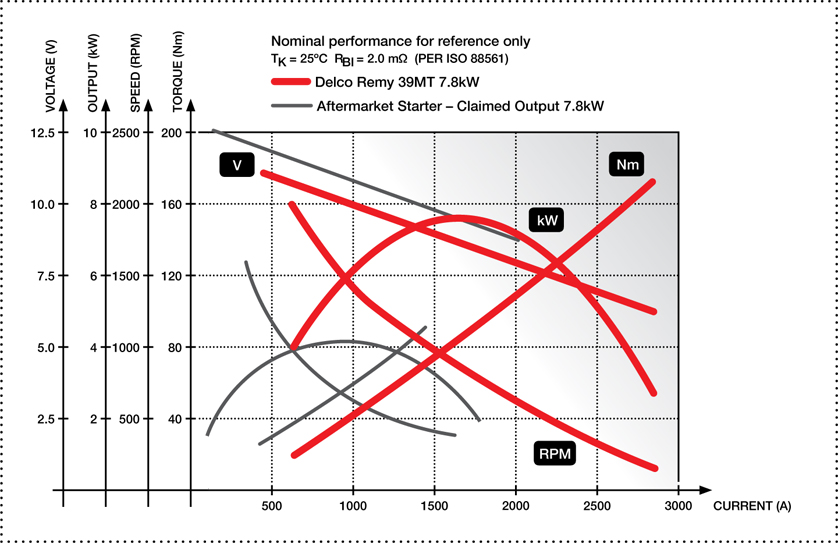
Slow Cranking: For the starter to be cranking, the control circuit would have to be working. So, if battery and cable checks are within specification and the vehicle still cranks slowly, then it’s a slow cranking problem and it’s time to replace the starter.
Click No-Crank: Check the control circuit. If the starter does not contain an Integrated Magnetic Switch, or IMS, then a voltage drop test will need to be performed on the vehicle control circuit. If the starter does have an IMS switch function, then the technician will have to verify that the vehicle’s control circuit is providing voltage to the starter IMS.
No-Click No-Crank: When this occurs, power is not being sent to the solenoid, making it very unlikely that the issue is related to the starter motor. A diagnostic tool can help you diagnose the complete starting and charging system, including the alternator, batteries, starter motor and wiring. The diagnostic tool can perform a full system check in about 25 minutes, making it a great investment for your workshop. So in a poor starting environment, or when a starter motor has failed, what could be wrong? Batteries – By now you should have tested your batteries and replaced any that were faulty. Don’t be tempted by the false-economy of leaving one poor quality battery in a bank of four. And you should look at your battery cabling, as this can often be less than optimum from new. In the diagram below, the top illustration shows the original battery cable layout, which results in the two inner batteries working hard and the outermost two never receiving optimum charge. In the diagram below (Pic 1) shows an easy solution to balance the workload of the battery banks.
 Tips from:http://www.dieselnews.com.au
Cranking problems can be frustrating, identifying and correcting the root cause does not have to be. The first step is to identify the symptoms. In a cranking system, you can divide your symptoms into one of three possible troubleshooting categories:
Slow Crank: The Mitsubishi starter will crank, however, the engine RPM is too slow to start the vehicle.
Click No-Crank: The solenoid clicks but the starter doesn’t crank.
No-Click No-Crank: The solenoid doesn’t click and the starter doesn’t crank.
Once you’ve identified which problem you’re dealing with, then you can start to remedy it. For all issues, the initial troubleshooting is the same: you start with the batteries.
STEP 1 – Begin at the batteries: Charge the batteries and perform a load test on each battery in the battery bank. If any batteries aren’t up to spec they need to be replaced or you will shorten the life of the other batteries and compromise the health of the starting circuit.
STEP 2 – Perform a voltage drop test: Once the batteries pass your tests, perform a voltage drop test on the starter main cables. The starter voltage drop should be less than .5V total on the cranking circuit. This is an important step and is often the cause of a slow cranking complaint. Yet voltage drop also is a leading cause of click or no-click complaints because almost every vehicle manufacturer uses the heavy positive post, located on the starter solenoid, as a place to pick up the current used to supply the control circuit.
STEP 3 – Identify the specific issue: Until now, the diagnostic path has remained the same regardless of the complaint. Now is where you address the specific issue.

Tips from: www.dieselnews.com.au